Practical Solutions: Choosing the Right Home Projector Screen
Advertisements
Choosing the right home projector screen is crucial for an immersive viewing experience. This guide explores seven practical factors, from screen material to ambient light rejection, ensuring optimal viewing for any home theater enthusiast. Understanding these elements is key to maximizing your projection system’s potential.
Practical Solutions: Choosing the Right Home Projector Screen – 7 Factors for Optimal Viewing
Selecting the ideal projector screen for your home theater involves more than just picking a size. It requires careful consideration of several technical and environmental factors.
Advertisements
To achieve an unparalleled cinematic experience, understanding these elements is paramount. This guide provides **Practical Solutions: Choosing the Right Home Projector Screen – 7 Factors for Optimal Viewing** to help you make an informed decision.
Understanding Screen Material and Gain for Optimal Viewing
The screen material is the foundation of your projected image quality. Different materials are designed to enhance specific aspects of viewing, from brightness to contrast.
The concept of ‘gain’ dictates how much light the screen reflects back to the viewer. A higher gain means a brighter image, but it can sometimes narrow the viewing angle.
For **Practical Solutions: Choosing the Right Home Projector Screen – 7 Factors for Optimal Viewing**, understanding material properties is critical.
The Impact of Screen Gain on Image Brightness
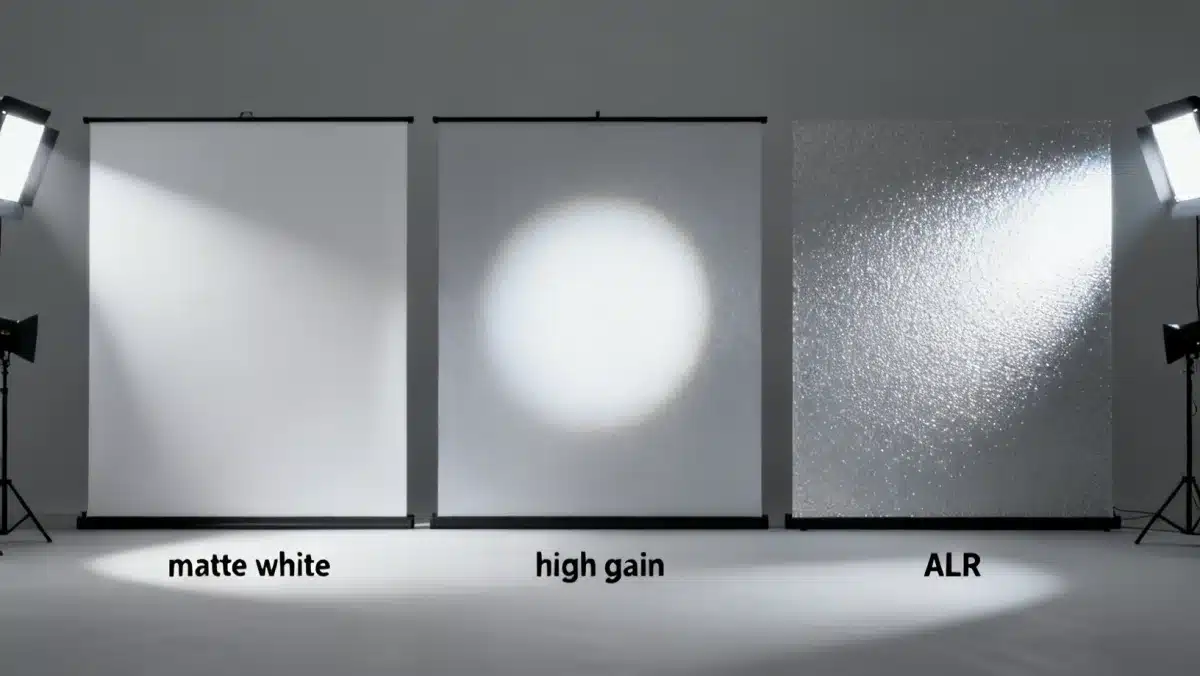
Screen gain measures a screen’s reflectivity compared to a standard matte white surface. A gain of 1.0 is considered neutral, reflecting light uniformly.
Screens with a gain higher than 1.0 amplify light, making the image appear brighter, which is beneficial in rooms with some ambient light.
Conversely, lower gain screens (below 1.0) offer wider viewing angles and better color accuracy, often preferred in dedicated dark rooms.
Types of Screen Materials and Their Applications
Matte white screens are versatile, offering accurate color reproduction and wide viewing angles. They are excellent for controlled lighting environments.
High-gain screens are ideal for situations where the projector’s lumen output is low or ambient light is present. They boost brightness but can introduce hotspots.
Acoustically transparent screens allow sound to pass through, enabling speaker placement behind the screen for a more immersive audio experience.
Ambient Light Rejection (ALR) Technology
Ambient light is the arch-nemesis of projector screens, washing out colors and reducing contrast. ALR screens are engineered to combat this challenge.
These screens feature specialized optical coatings and micro-structures that selectively reflect light from the projector while absorbing light from other sources.
Implementing **Practical Solutions: Choosing the Right Home Projector Screen – 7 Factors for Optimal Viewing** often involves addressing ambient light effectively.
How ALR Screens Enhance Contrast in Lit Rooms
ALR screens utilize angular reflectivity, directing projector light towards the viewer and deflecting overhead or side lighting away. This maintains image integrity.
The result is a significantly improved contrast ratio and deeper blacks, even in environments that are not completely dark.
For living rooms or multi-purpose spaces, ALR technology is a game-changer for **Practical Solutions: Choosing the Right Home Projector Screen – 7 Factors for Optimal Viewing**.
- ALR screens significantly improve image contrast in rooms with uncontrolled lighting.
- They use specialized optical layers to absorb ambient light and reflect projector light.
- Ideal for maximizing projector performance in non-dedicated home theater spaces.
- Available in various fixed frame or retractable formats to suit different installations.
Screen Size and Aspect Ratio Considerations
Choosing the correct screen size is crucial for an immersive experience without causing eye strain. It depends on your viewing distance and room dimensions.
The aspect ratio of your screen should match the content you primarily watch. Most modern content is 16:9, but 2.35:1 (Cinemascope) is popular for film enthusiasts.
These are fundamental **Practical Solutions: Choosing the Right Home Projector Screen – 7 Factors for Optimal Viewing** that directly impact comfort and engagement.
Calculating Optimal Viewing Distance for Screen Size
A common guideline suggests that the viewing distance should be 1.5 to 2.5 times the diagonal measurement of your screen. This creates an immersive yet comfortable field of view.
For example, a 100-inch screen would ideally be viewed from 10 to 20 feet away. Personal preference and room acoustics also play a role.
Careful calculation ensures that your chosen screen size provides the best possible experience, a key element of **Practical Solutions: Choosing the Right Home Projector Screen – 7 Factors for Optimal Viewing**.
Fixed Frame vs. Retractable Screens
Fixed frame screens offer a perfectly flat, tensioned surface, ensuring no wrinkles or waves, which is paramount for image uniformity.
Retractable screens provide flexibility, disappearing when not in use, making them excellent for multi-purpose rooms where a permanent screen isn’t desired.
Deciding between these types is a practical step in finding **Practical Solutions: Choosing the Right Home Projector Screen – 7 Factors for Optimal Viewing**.
Advantages and Disadvantages of Each Type
Fixed frame screens are generally less expensive for their size and easier to install permanently. They maintain optimal flatness over time.
Retractable screens, especially motorized ones, offer convenience but can be more prone to minor waves or curling over time, impacting image quality.
Electric tab-tensioned retractable screens minimize this issue by applying tension to the sides of the screen material, keeping it taut.
Projector-Screen Compatibility
Not all screens are created equal for all projectors. The type of projector you own or plan to purchase significantly influences your screen choice.
For instance, ultra-short throw (UST) projectors require specialized screens with unique optical structures to properly reflect light from their steep projection angle.
Ensuring compatibility is a vital part of **Practical Solutions: Choosing the Right Home Projector Screen – 7 Factors for Optimal Viewing**.
Matching Screen Features to Projector Technology
High-resolution projectors (4K, 8K) benefit from screens with fine surface textures to prevent pixelation artifacts. Smooth surfaces enhance image clarity.
For high-lumen projectors, a lower gain screen might be preferable to avoid hotspots and maintain color accuracy across the entire image.
Acoustically transparent screens are best paired with projectors that allow for accurate speaker placement behind them, enhancing the soundstage.
Installation and Mounting Options
The physical installation of your projector screen impacts both performance and aesthetics. Proper mounting ensures optimal viewing angles and screen flatness.
Options range from permanent wall mounts for fixed frames to ceiling-recessed electric screens that disappear completely when not in use.
Considering installation early on is a key aspect of **Practical Solutions: Choosing the Right Home Projector Screen – 7 Factors for Optimal Viewing**.
DIY vs. Professional Installation Considerations
Many fixed frame screens are relatively straightforward for a DIY installation, requiring basic tools and a level. Clear instructions are usually provided.
Retractable screens, especially motorized and recessed models, often benefit from professional installation due to wiring, alignment, and structural considerations.
Incorrect installation can lead to wrinkles, uneven tension, or alignment issues that detract from the viewing experience.
Budget and Future-Proofing Your Investment
Projector screens come in a wide range of price points, influenced by material, size, features, and brand. Establishing a budget early helps narrow down choices.
Consider future-proofing your investment. A higher-quality screen today might better support future projector upgrades or evolving viewing habits.
Balancing cost with long-term value is a crucial element of **Practical Solutions: Choosing the Right Home Projector Screen – 7 Factors for Optimal Viewing**.
Maximizing Value Without Compromising Quality
While premium screens offer superior performance, excellent options exist across all price segments. Focus on the features most relevant to your specific room and projector.
Prioritize screen material and ambient light rejection if your viewing environment is not perfectly dark. These factors often have the biggest impact on perceived image quality.
Investing in a high-quality screen ensures that your projector’s capabilities are fully realized, providing exceptional value over its lifespan.
Looking Ahead
The landscape of home projection continues to evolve, with advancements in screen technology complementing increasingly powerful projectors. Understanding the seven factors discussed – screen material, gain, ALR, size, aspect ratio, screen type, projector compatibility, installation, and budget – provides a robust framework for making an informed decision. As resolution and brightness capabilities of projectors advance, the screen’s role in delivering the final image becomes even more critical. These **Practical Solutions: Choosing the Right Home Projector Screen – 7 Factors for Optimal Viewing** ensure that your home theater remains at the forefront of immersive entertainment, ready for the innovations yet to come.